Most people only think about this problem once they're already stuck. You're in a hotel room at 6am, there's no coffee maker, and the nearest Starbucks is a 15-minute drive. Or you're in a college dorm and the shared kitchen is locked. Or you're parked at a campsite trying to make instant oatmeal with no fire ring and no plan.
The stove is something most of us take for granted until we don't have one. But hot water is one of those things that's almost always achievable regardless of where you are, as long as you know what your options actually are.
This covers seven real methods that work across all kinds of situations, from dorm rooms and offices to backcountry camping and long road trips. Some are obvious. A couple might surprise you.
1. Electric Kettle (The One You Actually Want)
Nothing on this list comes close. An electric kettle heats water faster than a stovetop, uses less energy, shuts itself off automatically, and fits anywhere you have an outlet and a few inches of counter space. Plug it in, press the switch, boiling water in two to four minutes. That's the whole story.
What makes it the right answer for most people is how many problems it solves at once. Morning coffee before anyone else is awake. Tea at your desk without leaving the room. Instant oatmeal in a dorm where the kitchen closes at 10pm. Ramen at midnight. A hot water bottle when you're sick and don't feel like doing anything. The kettle handles all of it without asking anything from you except an outlet.
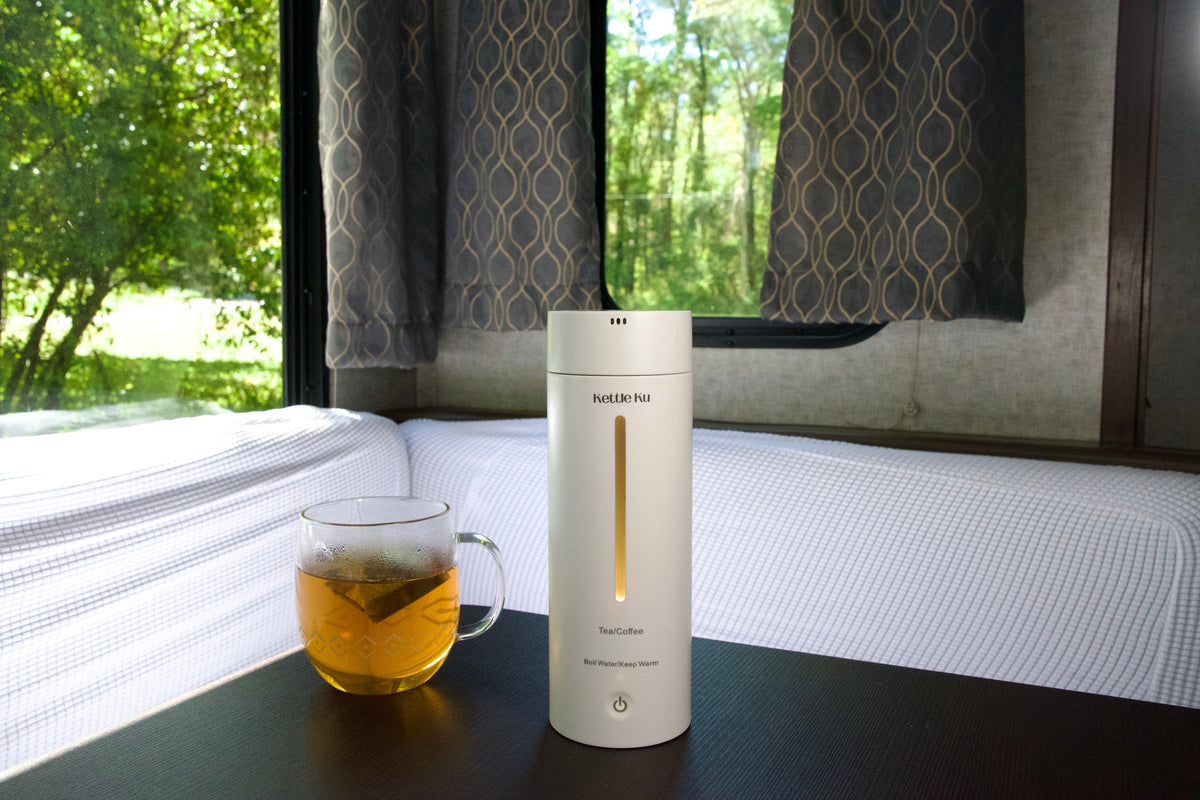
The Kettle Ku electric kettle is what we built for exactly this. Fast heat, a precision pour spout that doesn't drip on your desk, auto-shutoff so you don't have to babysit it, and a size that fits on a nightstand if that's what your space calls for. It travels well, it looks good, and it doesn't feel like a compromise the way a lot of small appliances do.
People who buy it tend to say the same thing: they didn't realize how much they needed it until they had one. Morning routine gets faster. The office situation gets easier. Hotel rooms feel more livable. It's a small thing that pays off constantly.
If there's one thing worth buying from this entire article, it's this. Shop the Kettle Ku here and stop making hot water harder than it needs to be.
2. Microwave
Before anything else, there's a safety thing to cover here. Microwaves heat water unevenly, which can cause something called superheating. Water heats past its boiling point without actually bubbling, and then erupts the moment you move the cup or drop something in it. It's not common, but it happens, and it can cause burns.
The fix takes two seconds: put a wooden chopstick, a stir stick, or a microwave-safe spoon in the water before you heat it. That gives the water something to nucleate bubbles around, which prevents superheating. The FDA has a short explainer on microwave water safety if you want the full breakdown.
With that handled, the microwave works fine for single cups when nothing else is available. Heat in 90-second increments, check the temperature between rounds, and don't push it past what you need. It's slower and less consistent than a kettle, but for a quick cup of tea in an office break room, it does the job.
3. Immersion Heater
These are small metal coils that drop directly into a cup of water and heat it from the inside. You've probably seen them at travel stores or airport gift shops and wondered who actually buys them. The answer is people who travel frequently and want hot water in countries where the hotel room has no kettle and the power outlets are a different voltage.
Immersion heaters are tiny, cheap, and weigh almost nothing. They heat one cup at a time and they heat slowly compared to a kettle, but they pack into a toiletry bag and they work in situations where bigger appliances don't. The main trade-off is that most have no automatic shutoff, so you stay close while they run.
If you're buying one for international travel, check that it handles dual voltage or comes with an adapter. A coil heater running on the wrong voltage burns out fast and sometimes dramatically.
4. Single-Serve Coffee Machine
Almost every office break room and hotel room in the country has a Keurig or something similar. Most people only use them for coffee or tea pods, but they'll dispense hot water on their own if you run a brew cycle without a pod loaded.
The water won't reach a true 212°F boil in most cases. These machines are calibrated for brewing, not for hitting precise temperatures. But they get water hot enough for instant soup, oatmeal, hot chocolate, or a cup of tea when you don't need the temperature to be exact.
Run a plain water cycle first to flush any residue from the previous user, especially in shared office machines or hotel rooms. Then run your actual cup. Quick, easy, nothing to plug in that you don't already have access to.
5. Portable Induction Cooktop
Induction cooktops are a different category from the other options on this list because they give you actual cooking capability, not just a way to boil water. A single burner unit plugs into a standard wall outlet and heats induction-compatible cookware directly through magnetic energy. No open flame, no coil, no residual heat on the surface itself.
They're compact enough to fit in a cabinet, heat fast, and work well for extended situations where you need more than just hot water. A long-term Airbnb without a full kitchen, a studio apartment with a broken range, an RV with limited built-in appliances. A portable induction cooktop functions like a real burner for most purposes.
The compatibility thing matters: your cookware needs a flat magnetic base for induction to work. Hold a magnet to the bottom of your pot before you assume it'll work. Cast iron, most stainless steel, and many modern nonstick pans are compatible. Aluminum and copper usually aren't.
For a dorm room or a hotel stay, this is probably more than you need. But if you're setting up a semi-permanent living situation without full kitchen access, it's worth having.
6. Solar Kettle
A solar kettle is an insulated tube that concentrates sunlight to heat water inside it. No electricity, no fuel, no fire. On a clear day with direct sun, it can bring water to a boil in 30 to 60 minutes depending on conditions and how well you angle it toward the sun throughout the process.
These are popular with backpackers and long-distance hikers who want to reduce fuel weight on extended trips. Carrying a canister of camp fuel adds up over multiple days. A solar kettle weighs almost nothing and produces nothing you need to pack out.
The honest limitation is that they require patience and sunshine. A cloudy morning or a shaded campsite slows things down considerably. They're best as a primary tool in sunny climates or a backup option paired with a fuel stove. REI's guide to camp cooking tools has a broader overview of outdoor heating options if you're trying to decide what makes sense for your setup.
7. Portable Camp Stove
When there's no electricity and no sunlight to work with, a camp stove is the most dependable option. Canister-style backpacking burners are light, wind-resistant, and can boil a liter of water in under four minutes. Car campers usually have a two-burner propane setup that works essentially like a home range.
This one has an obvious context. It belongs in a camping bag or a road trip kit, not in a dorm room. But for anyone spending time somewhere without power, whether that's a remote campsite, a cabin without hookups, or a situation where the grid goes out, a camp stove with fuel is the most reliable way to get water boiling.
A few things to keep in mind for safety: use camp stoves outside or in well-ventilated areas, never inside a tent or enclosed space. In wind, use a stove windscreen or block the burner with your body to maintain a consistent flame. The CDC has resources on carbon monoxide safety that apply anytime you're burning fuel in close quarters.
Which One Actually Makes Sense for You
For camping and off-grid situations, a camp stove or solar kettle makes sense. For international travel with no guaranteed outlet situation, an immersion heater earns its spot in the bag. And for the microwave, it's fine when there's nothing else.
But for 90% of situations, an electric kettle is the answer. Dorms, offices, apartments, hotel stays, road trips, early mornings, late nights. The Kettle Ku was built to cover all of it without taking up your whole counter or your whole budget.
Fast heat. Clean pour. Auto-shutoff. A size that fits anywhere. It's the kind of thing you buy once and reach for every single day without thinking about it.
Get the Kettle Ku Electric Kettle and have hot water ready whenever you need it.